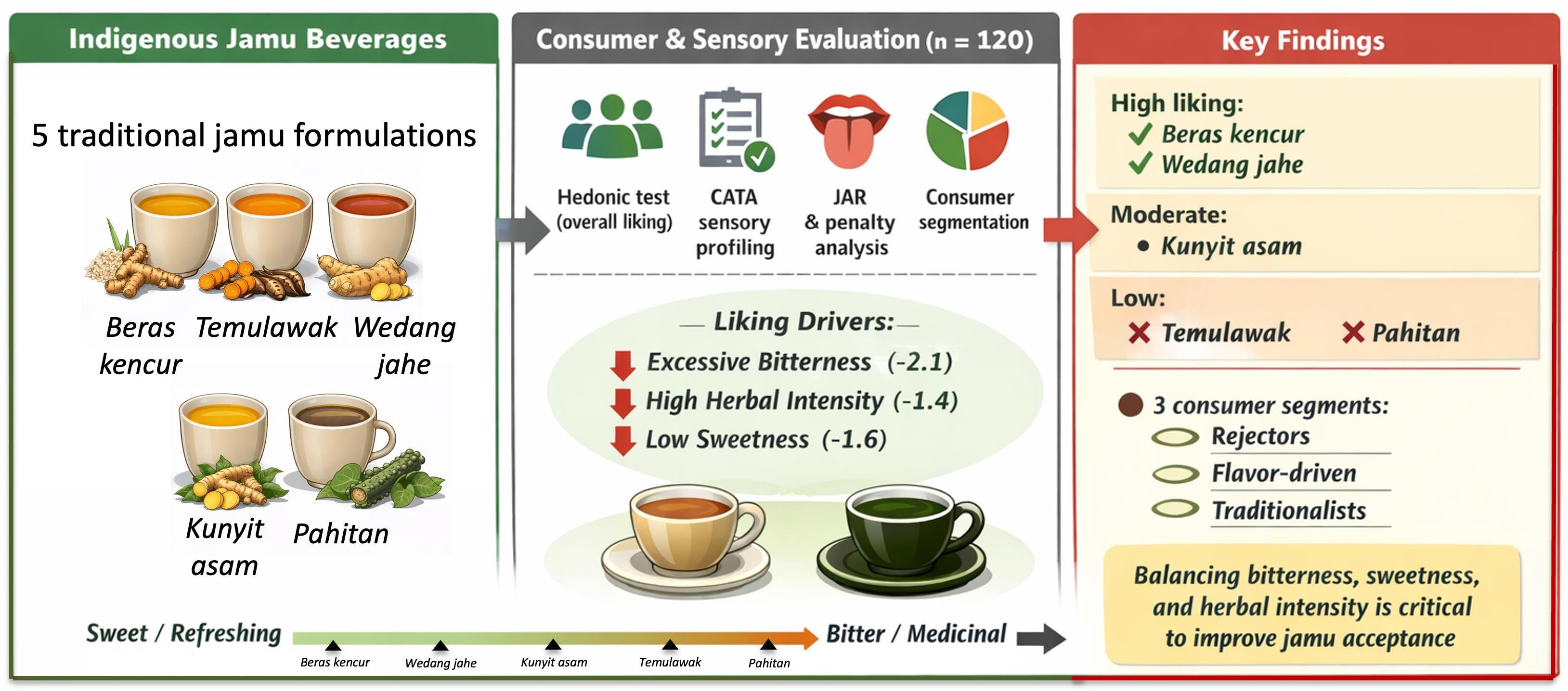

Profiling of Consumer Perception and Acceptance of Indigenous Jamu Beverages

 , ,
, ,  and
and 
Abstract
1. Introduction
2. Materials and Methods
2.1. Jamu Samples Preparation
2.2. Sensory Evaluation
2.2.1. Panel Recruitment
2.2.2. Hedonic (Liking) Evaluation [12]
2.2.3. Check-All-That-Apply (CATA) and Profiling of Consumer Perception [13]
2.2.4. Just-About-Right (JAR) Evaluation and Penalty Analysis [14]
2.3. Statistical Analysis
3. Results
3.1. Consumer Characteristics and Overall Liking of Jamu Beverages
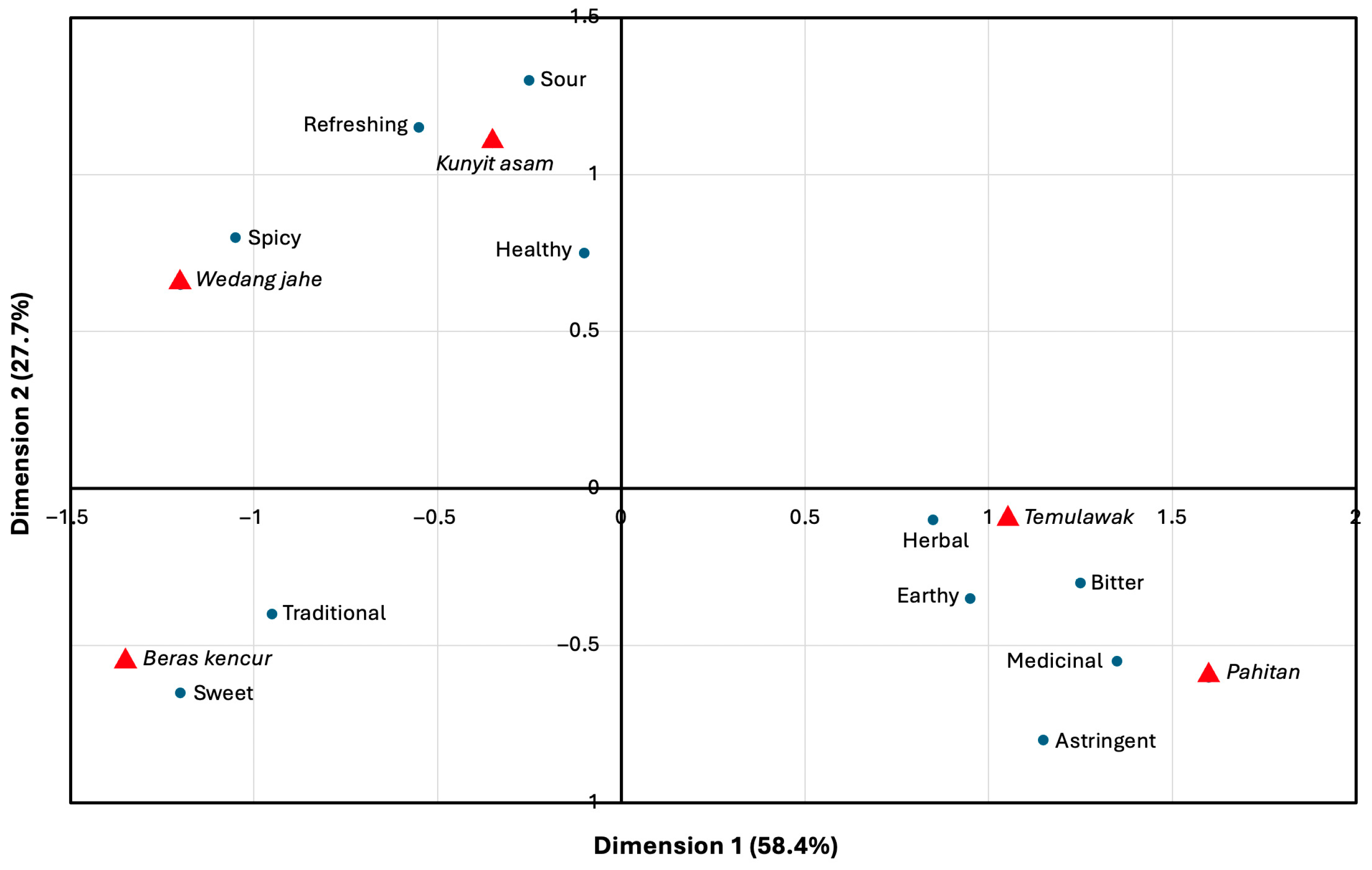
3.2. Consumer Perception Profile of Jamu Beverages Using CATA and Correspondence Analysis
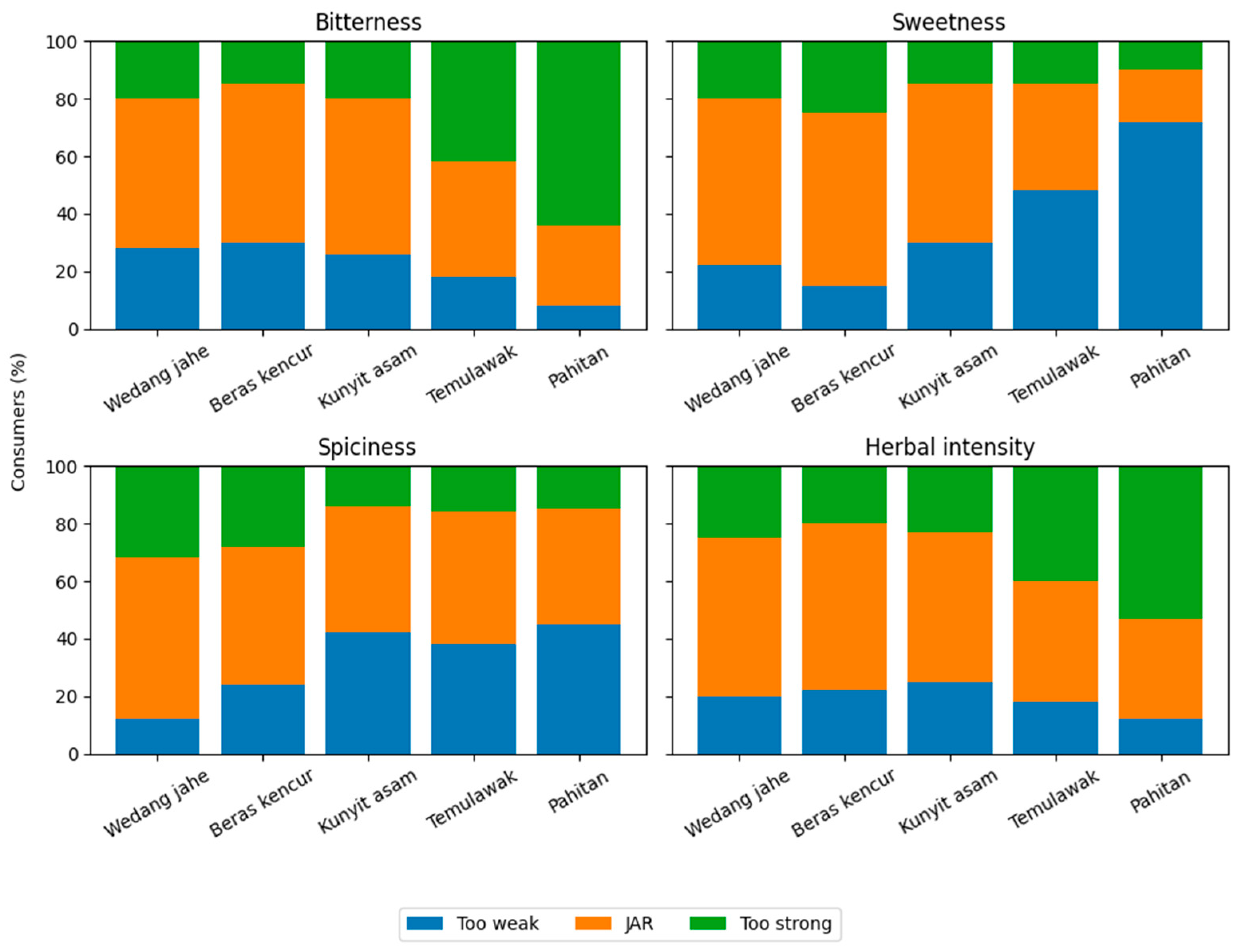
3.3. JAR Evaluation and Penalty Analysis of Key Sensory Attributes of Jamu Beverages
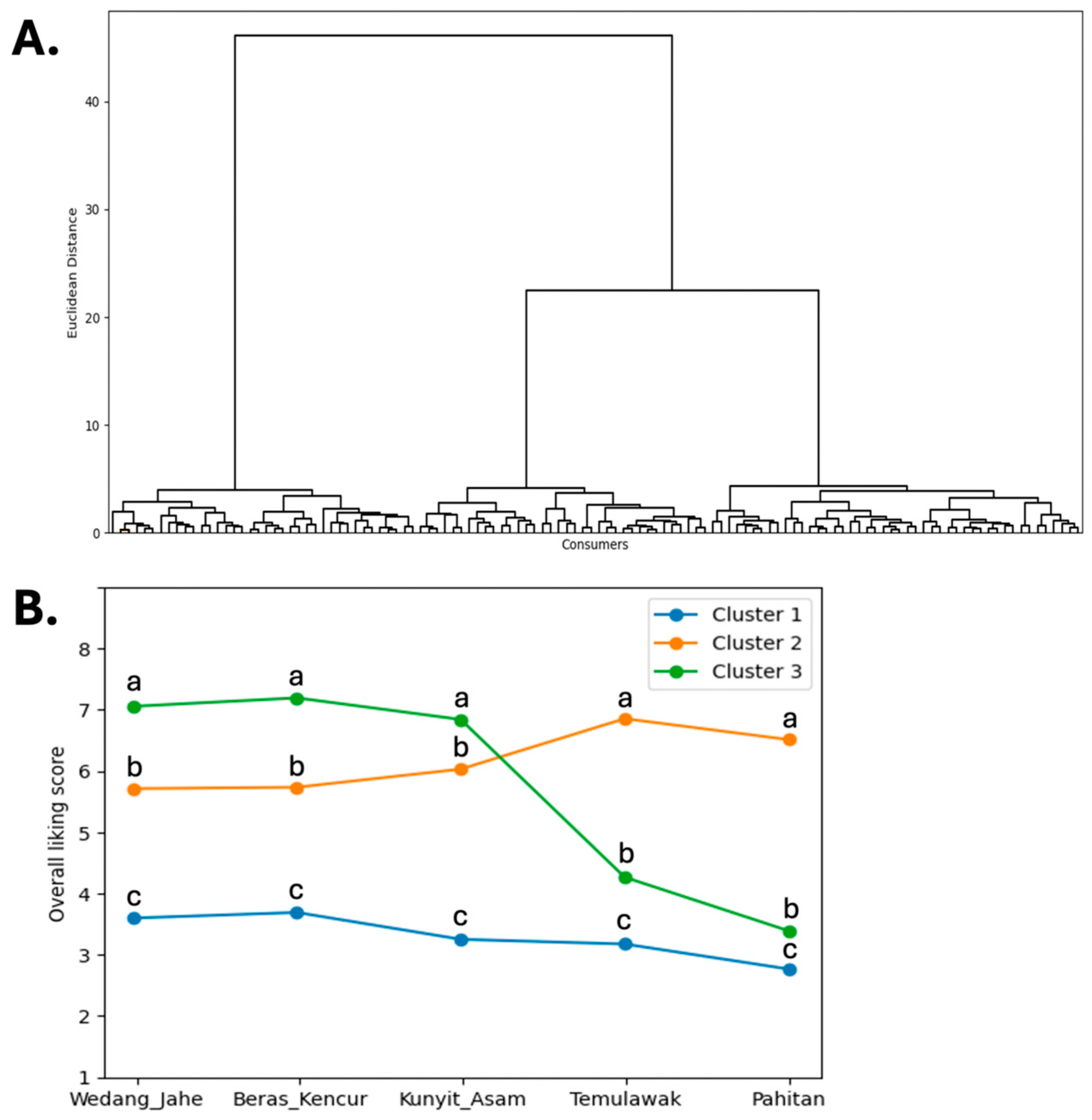
3.4. Consumer Segmentation Based on Overall Liking Patterns
4. Discussion
5. Limitations
6. Conclusions
Author Contributions
Funding
Institutional Review Board Statement
Informed Consent Statement
Data Availability Statement
Conflicts of Interest
Abbreviations
| CATA | Check all that apply |
| JAR | Just about right |
References
- Beers, S.J. Indonesian Herbal Healing: The Science and Lore of Jamu Herbal Preparations and Treatments; Tuttle Publishing: Tokyo, Japan, 2024. [Google Scholar]
- Nurcholis, W.; Arianti, R. Jamu as Indonesian cultural heritage and modern health innovation. J. Jamu Indones. 2024, 9, 1–2. [Google Scholar] [CrossRef]
- Rahayu, M.B. Indonesia Has More than Two Million Jamu Variants That Can Be Developed (Document in Indonesian). Detik News. Available online: https://news.detik.com/berita/d-3329447/indonesia-punya-2-juta-lebih-varian-jamu-yang-bisa-dikembangkan (accessed on 9 January 2026).
- Surya, R.; Romulo, A.; Nurkolis, F.; Kumalawati, D.A. Compositions and health benefits of different types of jamu, traditional medicinal drinks popular in Indonesia. In Natural Products in Beverages: Botany, Phytochemistry, Pharmacology and Processing; Springer International Publishing: Cham, Switzerland, 2023; pp. 1–33. [Google Scholar]
- Tripoli, F.; Wahyono, B. Traditional medicine (Jamu) in modern medical discourse. Int. J. Soc. Sci. 2015, 25, 55–65. [Google Scholar]
- Afdhal, A.F.; Welsch, L. Jamu. In The Context of Medicines in Developing Countries: Studies in Pharmaceutical Anthropology; Berghahn Books: New York, NY, USA, 2012; pp. 149–160. [Google Scholar]
- Gondokesumo, M.E.; Muthmainnah, A.S. Benefits of Indonesian scientific jamu in the treatment of various diseases: A review. Indones. J. Pharm. Sci. Technol. 2024, 6, 71–88. [Google Scholar]
- Estiasih, T.; Maligan, J.M.; Witoyo, J.E.; Mu’alim, A.A.H.; Ahmadi, K.; Mahatmanto, T.; Zubaidah, E. Indonesian traditional drinks: Diversity, processing, and health benefits. J. Ethn. Foods 2025, 12, 7. [Google Scholar] [CrossRef]
- Fibrianto, K.; Putri, V.D.; Regina, G.M. Consumer sensory perception of jamu gendong: A traditional Javanese drink. In BIO Web of Conferences; EDP Sciences: Les Ulis, France, 2025; Volume 165, p. 07003. [Google Scholar]
- Fibrianto, K.; Zubaidah, E.; Bimo, I.; Miftachurrochmah, A.; Safindra, N.; Putri, B.N. Gen Z sensory perspective on turmeric-based jamu transformed into kombucha through a convolutional neural network approach. Canrea J. Food Technol. Nutr. Cul. 2025, 8, 246–253. [Google Scholar] [CrossRef]
- Sumarni, W.; Sudarmin, S.; Sumarti, S.S. The scientification of jamu: A study of Indonesian traditional medicine. J. Phys. Conf. Ser. 2019, 1321, 032057. [Google Scholar] [CrossRef]
- Cartwright, J.; Smyth, H.E.; Netzel, M.E.; Sultanbawa, Y.F.; Wright, O.R. A hedonic sensory trial exploring the relationship between sweet-liker status, demographics, and health measures in beverages. J. Sens. Stud. 2025, 40, e70008. [Google Scholar] [CrossRef]
- Aung, T.; Kim, B.R.; Kim, M.J. CATA- and RATA-based sensometric assessment of germinated wheat beverages. J. Food Sci. Technol. 2024, 61, 897–906. [Google Scholar] [CrossRef]
- Iserliyska, D.; Dzhivoderova, M.; Nikovska, K. Application of penalty analysis to interpret JAR data: A case study on orange juices. Curr. Trends Nat. Sci. 2017, 6, 6–12. [Google Scholar]
- Widowati, L.; Yulianto, A.; Budiarti, M.; Istifiani, L.A.; Pamungkas, S.A.; Ulhaq, Z.S. Exploring the potential of Indonesian herbal remedies using the jamu registry database. J. Herb. Med. 2024, 45, 100865. [Google Scholar] [CrossRef]
- Elfahmi, K.R.; Bos, R.; Kayser, O.; Woerdenbag, H.J.; Quax, W.J. Jamu: The Indonesian traditional medicine. In Phytochemical and Biosynthetic Studies of Lignans; Springer: Berlin/Heidelberg, Germany, 2006; Volume 13. [Google Scholar]
- Prasetya, F.; Hananta, L. Nutrigenomics and jamu: Integrating nutritional genomics with Indonesian traditional medicine. J. Trop. Pharm. Chem. 2025, 9, 299–318. [Google Scholar] [CrossRef]
- Jaeger, S.R.; Chheang, S.L.; Yin, J.; Bava, C.M.; Gimenez, A.; Vidal, L.; Ares, G. CATA responses elicited by consumers: Reproducibility and stability of sensory characterization. Food Qual. Prefer. 2013, 30, 56–67. [Google Scholar] [CrossRef]
- Drewnowski, A.; Gomez-Carneros, C. Bitter taste, phytonutrients, and the consumer. Am. J. Clin. Nutr. 2000, 72, 1424–1435. [Google Scholar] [CrossRef]
- Kataoka, M.; Tokuyama, E.; Miyanaga, Y.; Uchida, T. Taste evaluation of medicinal plants and Chinese medicines. Int. J. Pharm. 2008, 351, 36–44. [Google Scholar] [CrossRef]
- Charters, S.; Pettigrew, S. The dimensions of wine quality. Food Qual. Prefer. 2007, 18, 997–1007. [Google Scholar] [CrossRef]
- Prescott, J. Multisensory processes in flavour perception and their influence on food choice. Curr. Opin. Food Sci. 2015, 3, 47–52. [Google Scholar] [CrossRef]
- Feng, X.; Sun, Y.; Wang, G.; Feng, G.; Guo, J.; Wan, Z.; Yang, X. Suppression of sensory bitterness of beverages via nanoscale complex coacervation. Food Chem. 2025, 500, 147356. [Google Scholar] [CrossRef] [PubMed]
- Havermans, R.C.; van den Heuvel, E. Acquired tastes: On the learning of food preferences. In Flavor; Woodhead Publishing: Cambridge, UK, 2023; pp. 283–299. [Google Scholar]
- Mennella, J.A.; Bobowski, N.K. The sweetness and bitterness of childhood. Physiol. Behav. 2015, 152, 502–507. [Google Scholar] [CrossRef]
- Rocha, C.; Moura, A.P.D.; Cunha, L.M. Consumers’ associations with herbal infusions and home preparation practices. Food Qual. Prefer. 2020, 86, 104006. [Google Scholar] [CrossRef]
- Shaik, M.I.; Hamdi, I.H.; Sarbon, N.M. Traditional herbal drinks: Physicochemical, phytochemical, and pharmacological properties. Food Chem. Adv. 2023, 3, 100460. [Google Scholar] [CrossRef]
- Siegrist, M.; Shi, J.; Giusto, A.; Hartmann, C. Consumer acceptance of functional foods and beverages in Germany and China. Appetite 2015, 92, 87–93. [Google Scholar] [CrossRef] [PubMed]
- McSweeney, M.B. Effects of health-related claims on sensory perception. Curr. Opin. Food Sci. 2022, 47, 100893. [Google Scholar] [CrossRef]
- Hong, X.; Li, C.; Wang, L.; Gao, Z.; Wang, M.; Zhang, H.; Monahan, F.J. Effects of nutrition and health claims on sensory preferences and willingness to pay. Foods 2022, 11, 3460. [Google Scholar] [CrossRef] [PubMed]



| Jamu Type | Brand and Producer | Ingredients (as Written on Label) |
|---|---|---|
| Wedang jahe | Mustika Ratu, PT Mustika Ratu, Jakarta, Indonesia | Zingiber officinale rhizome extract (15%), natural sugar (85%) |
| Beras kencur | Sido Muncul, PT Sido Muncul, Semarang, Indonesia | Kaempferia galanga rhizome extract (25%), Oryza sativa (16%), Zingiber officinale rhizome extract (2%), Tamarindus indica pulp extract (2.4%), sugar, palm sugar, citric acid, salt. |
| Kunyit asam | Sido Muncul, PT Sido Muncul, Semarang, Indonesia | Curcuma domestica rhizome extract (20%), Tamarindus indica pulp extract (10%), citric acid, sucrose, salt. |
| Temulawak | Herbadrink, PT Konimex, Sukoharjo, Indonesia | Curcuma xanthorrhiza rhizome extract (26%), sugar, and other ingredients until 100%. |
| Pahitan | Paitan Resik, Perusahaan Jamu Ibu Tjipto, Tegal, Indonesia | Caesalpinia sappan Linn. (10%), Usnea barbata Fries. (10%), Curcumae rhizoma (15%), Andrographis paniculata Nees. (25%), Alstonia spectabilis R.Br. (35%), and other ingredients until 100%. |
| Demographic Variable | Category | Number of Panelists (n) | Percentage (%) |
|---|---|---|---|
| Gender | Male | 54 | 45.0 |
| Female | 66 | 55.0 | |
| Age (years) | 18–25 | 38 | 31.7 |
| 26–35 | 42 | 35.0 | |
| 36–45 | 26 | 21.7 | |
| >45 | 14 | 11.6 | |
| Education level | High school | 24 | 20.0 |
| Undergraduate | 66 | 55.0 | |
| Postgraduate | 30 | 25.0 | |
| Jamu consumption frequency | ≤1×/week | 50 | 41.7 |
| 1–3×/week | 42 | 35.0 | |
| ≥4×/week | 28 | 23.3 | |
| Primary reason for jamu consumption | Health-related | 62 | 51.7 |
| Habit/tradition | 30 | 25.0 | |
| Taste | 28 | 23.3 |
| Sample | Overall Liking Score |
|---|---|
| Wedang jahe | 7.05 ± 0.91 a |
| Beras kencur | 7.22 ± 0.84 a |
| Kunyit asam | 6.78 ± 0.89 b |
| Temulawak | 5.52 ± 1.12 c |
| Pahitan | 3.82 ± 1.19 d |
| Attribute | Wedang Jahe | Beras Kencur | Kunyit Asam | Temulawak | Pahitan | Q Test (p) |
|---|---|---|---|---|---|---|
| Bitter | 30 | 25 | 32 | 72 | 86 | <0.001 |
| Sour | 22 | 28 | 76 | 30 | 18 | <0.001 |
| Sweet | 26 | 78 | 62 | 28 | 14 | <0.001 |
| Astringent | 10 | 15 | 22 | 60 | 75 | <0.001 |
| Herbal | 42 | 48 | 52 | 82 | 86 | <0.001 |
| Earthy | 20 | 25 | 24 | 68 | 72 | <0.001 |
| Spicy | 82 | 58 | 32 | 36 | 26 | <0.001 |
| Medicinal | 30 | 32 | 38 | 82 | 90 | <0.001 |
| Refreshing | 62 | 55 | 72 | 24 | 10 | <0.001 |
| Healthy | 72 | 68 | 75 | 85 | 92 | <0.001 |
| Traditional | 65 | 70 | 62 | 72 | 78 | <0.001 |
| Attribute | Non-JAR Condition | Mean Drop in Liking | Consumers Penalized (%) |
|---|---|---|---|
| Bitterness | Too strong | −2.1 | 42 |
| Sweetness | Too weak | −1.6 | 38 |
| Spiciness | Too strong | −1.2 | 25 |
| Herbal intensity | Too strong | −1.4 | 30 |
Disclaimer/Publisher’s Note: The statements, opinions and data contained in all publications are solely those of the individual author(s) and contributor(s) and not of MDPI and/or the editor(s). MDPI and/or the editor(s) disclaim responsibility for any injury to people or property resulting from any ideas, methods, instructions or products referred to in the content. |
© 2026 by the authors. Licensee MDPI, Basel, Switzerland. This article is an open access article distributed under the terms and conditions of the Creative Commons Attribution (CC BY) license.
Share and Cite
Surya, R.; Kumalawati, D.A.; Tedjakusuma, F.; Subali, D.; Santini, A.; Nurkolis, F. Profiling of Consumer Perception and Acceptance of Indigenous Jamu Beverages. Beverages 2026, 12, 46. https://doi.org/10.3390/beverages12040046
Surya R, Kumalawati DA, Tedjakusuma F, Subali D, Santini A, Nurkolis F. Profiling of Consumer Perception and Acceptance of Indigenous Jamu Beverages. Beverages. 2026; 12(4):46. https://doi.org/10.3390/beverages12040046
Chicago/Turabian StyleSurya, Reggie, Dian Aruni Kumalawati, Felicia Tedjakusuma, Dionysius Subali, Antonello Santini, and Fahrul Nurkolis. 2026. "Profiling of Consumer Perception and Acceptance of Indigenous Jamu Beverages" Beverages 12, no. 4: 46. https://doi.org/10.3390/beverages12040046
APA StyleSurya, R., Kumalawati, D. A., Tedjakusuma, F., Subali, D., Santini, A., & Nurkolis, F. (2026). Profiling of Consumer Perception and Acceptance of Indigenous Jamu Beverages. Beverages, 12(4), 46. https://doi.org/10.3390/beverages12040046